

Developing Professional Adaptability in a Changing World
University of Denver, Josef Korbel School of Global and Public Affairs
Strategic Shift Strengthens Graduates’ Preparation for Tomorrow’s Challenges


The institution formerly known as the University of Denver’s Josef Korbel School of International Studies has a proud new name: the Josef Korbel School of Global and Public Affairs. “This change reflects the culmination of the school’s long evolution from its research roots into a professional school,” says Frederick “Fritz” Mayer, the school’s dean, “one that empowers future leaders to address the world’s most pressing issues in both global and domestic affairs.”
The new name also reflects the school’s pivot to meet this moment in history. “So much that we thought was settled is now unsettled,” Mayer explains. “We’re looking at the implications of a changed global balance of power, new roles for the private and nonprofit sectors, the AI revolution, and the fragile state of democracy around the world. And we’re reemphasizing the importance of equipping our students to think and act ethically.” As part of that commitment, Korbel is leading an effort by many of the world’s top schools of international and public affairs, funded by the Carnegie Corporation of New York, to rethink how to prepare students to lead in a changing world.
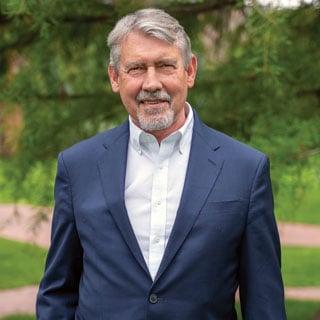
“There’s no denying that the career landscape has changed, and we’re adapting by assisting our students in finding work both domestically and internationally.” –Frederick Mayer, Dean, Josef Korbel School of Global and Public Affairs, University of Denver
This forward-thinking approach isn’t just about curriculum development; it’s profoundly shaped by the people who deliver it. The Korbel School boasts an extraordinary interdisciplinary faculty of leading scholars who are focused on finding solutions and equally passionate about teaching and mentoring. With its low student-to-faculty ratio and small class sizes, students can really engage with the faculty.
Further, as Mayer explains, “it’s important in a school where you’re training future professionals to have faculty with professional experience. Just one example is Carol Spahn, former director of the Peace Corps. She brings extraordinary experience, years of working in Africa in development, and her time at the Peace Corps. That’s the kind of person who offers so much, who can speak with extensive field experience, and understands the career options for students.”
This commitment to preparing well-rounded, effective global leaders extends beyond the classroom and past graduation. Korbel offers robust career services and support, which includes an extensive alumni network of over 7,000. “Our alumni are everywhere, doing amazing things in governments, in non-profits, and in the private sector,” Mayer says. “And they love nothing more than to pay it back by helping the next generation of Korbel graduates.”
An Ideal Vantage Point

Located in Denver, Colorado, Korbel’s distance from Washington, DC, allows for critical reflection. “Being in DC, it’s hard not to get drawn into the day-to-day drama,” says Mayer, “but there’s rarely a moment to step back and ask, ‘What’s the big strategy?’ As we like to say, ‘You can see far from here.’”
At the same time, Korbel’s location offers a close-up of what Mayer calls Colorado’s “very functional government” — a laboratory for approaching pressing issues and policymaking.
University of Denver, Josef Korbel School of Global and Public Affairs
korbel.du.edu
[email protected]
Contents
- Developing Professional Adaptability in a Changing World
- Georgetown University, School of Foreign Service
- University of Denver, Josef Korbel School of Global and Public Affairs
- Johns Hopkins School of Advanced International Studies
- The Fletcher School at Tufts University
- Rice University, School of Social Sciences
- Penn State University, School of International Affairs
- Augusta University, Pamplin College of Arts, Humanities, and Social Sciences
- Virginia Tech, School of Public and International Affairs
- American University, School of International Service
- Columbia University, School of International and Public Affairs
- The University of Texas at Austin, Clements Center for National Security
- George Washington University, Elliott School of International Affairs
- University of Toronto, Munk School of Global Affairs & Public Policy